Slow Currents
Slow Currents
Created by Rosabel Tan and Leah Jing McIntosh, Slow Currents is an international Asian diaspora writing workshop operating across Aotearoa, Australia, and beyond.
Formed through slow and intentional dialogue between Leah Jing McIntosh (Editor, Liminal) and Rosabel Tan (Director, Satellites), this programme centres the development of deep, meaningful relationships across borders — where writers have space to learn from one another and to potentially collaborate across literary forms — and to proactively evolve the discourse within Asian diasporic communities, exploring what a liberated form of artistic expression and migrant belonging might look like across our respective contexts.
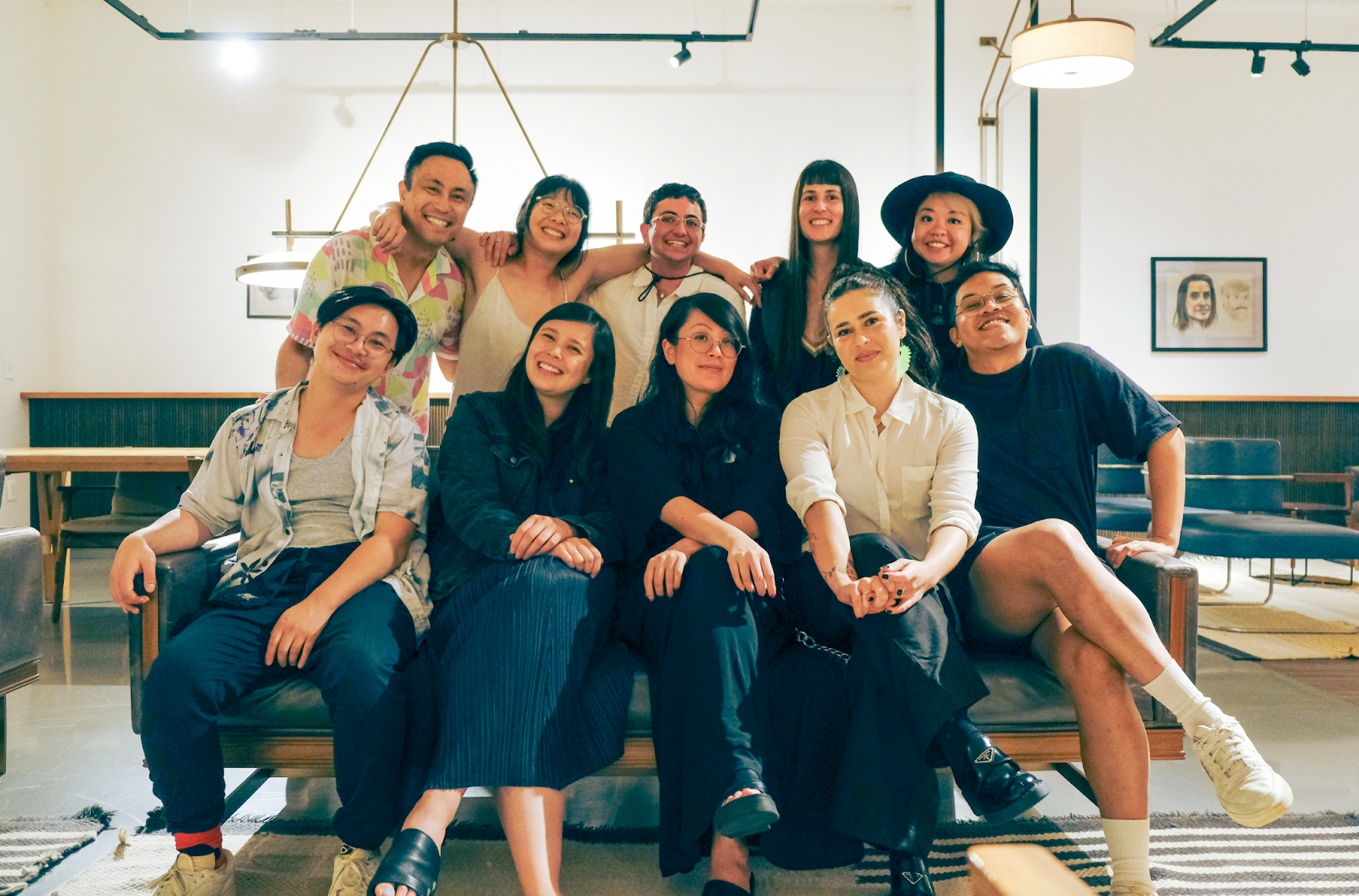
Our three-year pilot programme brought together eight early-career writers from across Australia and Aotearoa: Bryant Apolonio, Saraid de Silva, Elizabeth Flux, Hasib Hourani, Nathan Joe, Rose Lu, Cher Tan and Chris Tse. Read more about the programme convenors and participating writers here.
Year 1
The 2022 programme was presented online during lockdown in partnership with the Asian American Writers Workshop. Over a three-month period, we brought our cohort into dialogue with writers George Abraham, Piyali Bhattacharya, Alice Sparkly Kat, Hua Hsu, Viet Thanh Nguyen and Charles Yu.
As part of our design process, participants completed anonymous feedback forms after each session, enabling us to iteratively improve the programme and understand each writer’s experience of the workshop.
“This program is one of the best things to have happened to me as a creative”
“It’s like the workshop I’ve always dreamed of but didn’t know could actually be possible.”
“I’m realising that this programme is more like a leadership development course for us — this session in particular gave me some ideas about how we take a more (pro)active role in shaping how our work is presented and read.”
Year 2
In 2023, we travelled to Washington, DC at the invitation of the Smithsonian’s Asian American Literature Festival, where we intended to take part in a 10-day writing residency followed by the 3-day Festival.
The festival was unceremoniously cancelled by the Smithsonian only three weeks prior to our arrival. This cancellation of the festival led to an outpouring of support from the local writing community, who invited us to perform with them at events held at both The Kennedy Centre and at local bookstore Busboys and Poets. Slow Currents also co-organised and participated in the Ghosted World: Uncancelled Asian American Literary Festival, featuring six performances, meetings with poets and writers, and a closed roundtable for Asian diasporic programmers.
“[I found it valuable] being able to have conversations about writing and art with other Asian diaspora writers in a safe space. In some ways, it has been about relearning how I approach discussions about these topics without falling back on colonial/Western tropes and frameworks.”
“The residency time has been invaluable— there is so much deep thinking that has to go into a novel, and that sort of thinking I find really hard to fit into my normal life due to the demands of working full time.”
“It was special being so deeply engaged in the work of other Asian writers, as well as workshopping alongside them. This provides a higher bar to strive towards than simply working alone. It keeps one accountable. It keeps one aspirational. One wants to keep up. The value of having a cohort to discuss ideas.”
Year 3
In our third and final year, we drew on the learnings of our previous two years to create a programme that involved travelling to Te Whanganui-a-Tara Wellington for a residency alongside appearances at Verb Festival (in person) and the Asian American Literature Festival (online).
“Year 3 of Slow Currents was such a generative and nourishing process. Being in the third year of conversations about our work meant that the conversations were deeper, the engagement was stronger, and the level of safety and support from the group was higher. I feel simultaneously inspired by the group and also wanting to push myself more creatively because of the depth of knowledge and skill within the group. It's also really grounding to see how much things change over time, and how much happens for people and their work in successive works. It makes the very Sisyphean task of writing a novel feel achievable.”
“Year 3 was a much deeper connection than years 1 and 2, I felt like after the residency last year, everyone knew each other SO much better and I loved coming back to a familiar and comforting group.”
“The fact that we’ve all become closer as a group, and familiar with each others’ work, style, and writing process, I think gives the workshop feedback much more depth.”
We also invited the writers to anonymously reflect on the programme as a whole:
"Slow Currents allowed me to write new work, empowering me with time and space, and a group of peers who made me want to be a better writer. It was a necessary contribution to the ecology of our still-growing landscape, providing unique opportunities not offered elsewhere. A time I will not forget."
“Having the way cleared to write meant I gave more of myself to my work. It feels like permission to do so, and that is something I always need. Someone else's belief and support in my work, which is what the Slow Currents program is, is so precious.”
“I miss everyone already—the pairing was perfect! Many creative writers don't thrive in regularised group settings due to neuroses and/or neurodivergence but the program showed that it is indeed possible that everyone gets along and accepts one another's quirks and personality drama-free!”
“In the short term, I have a writing project that is now completed to a level that would not have been possible without this program, and I have feedback from the other writers involved that will allow me to improve this specific work now that I have returned home. In the longer term, I have learned new ways of approaching writing that will shape my work going forward.”